
🙏 In Her Papers
What was never said, and how it reached me

“This is my letter to the World / That never wrote to Me —” —Emily Dickinson, Poem 441 (c. 1862)
“Even before a word is on my tongue, behold, O Lord, you know it altogether” (Psalm 139:4, ESV).
My mother died in October 2024. A few weeks later, I began going through her papers. She had kept everything in the orderly, unspectacular way of a woman who trusted filing cabinets. Birth certificates. Warranty cards from appliances no longer in service. Our first family dog’s vaccination records, yellowed at the edges.
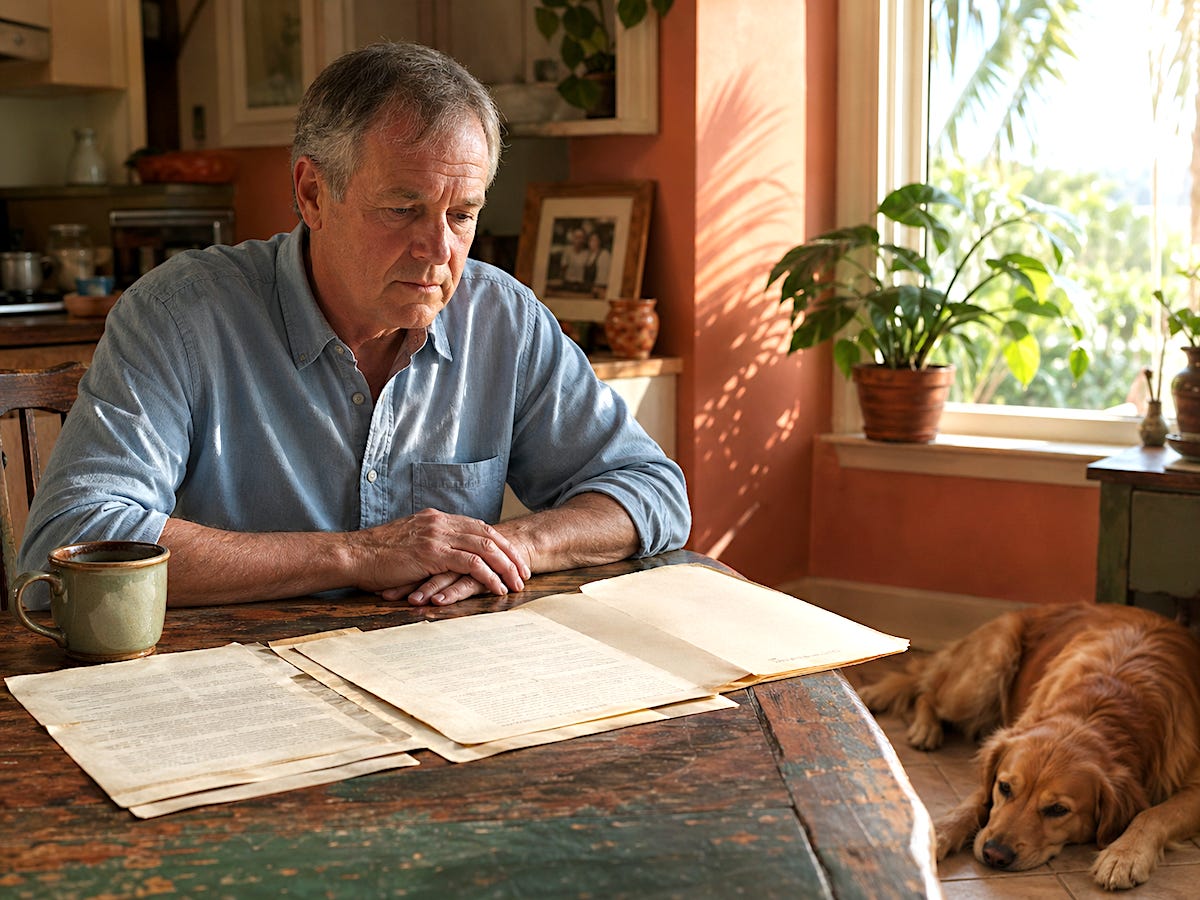
In one folder, I found the paperwork related to my adoption.
I knew I was adopted. My parents never hid it. I’ve written about it in this column before. What I didn’t know were the small, specific details in those pages: a hospital, a town, an age. Not a name; that was the custom then. Nothing shocking. Nothing hidden from me. It was the ordinary residue of a decision made by a stranger in 1964 — a young woman signing forms in an office somewhere, beginning a life that would not include me, releasing me into the one that would.
I sat at the table for a long time.
This month, we’ve been talking about what we say. Easter Sunday was about the gap between witnessing and speaking. The two weeks after were about the voice in our own heads and the space between what we mean and what actually comes out. This week, we arrive at something more intimate. The speech that shaped us, that we did not write, that no one said to us aloud.
The sentences in those pages were not composed for me. A clerk wrote them. A lawyer signed them. A social worker noted them. Decades later, my mother held them. Now they sit in my house.
My birth mother never wrote me a letter. She may have meant to. She may not. In 1964, young women who gave up their children were often counseled to walk away cleanly and not look back. She did what she was told. What she thought, she kept inside herself. What she might have said, she never said.
The folder itself became a kind of letter. She didn’t write it. It carries her age and her place. Not her name. She stayed anonymous in her own record.
Your own box may hold something else. Medical records about a parent you never got to ask. A letter to a lawyer you weren’t meant to read. A diary entry dated before you were born. A photograph with a name written on the back in a hand you don’t recognize. For some, the discovery is of minutiae. Others find something that upends everything they thought they knew.
Simone Weil wrote that absolutely unmixed attention is prayer. I’ve thought about that line for months. Sitting at the table with those pages, I understood it differently. To read carefully, without inventing, without flinching, is a form of attention. When the person you’re reading about can no longer answer, the attention becomes something close to prayer, in whatever sense of that word you can accept.
We arrive at April’s end more quietly than we began. Consider the papers you may one day inherit, or the ones you already have. You may find yourself reading, years later, what no one ever said to you aloud.
This article appeared in FLORIDA TODAY as My mother’s death revealed details about my adoption story | Spirituality Today.