

A Pi Day reflection on the patterns we keep walking past.
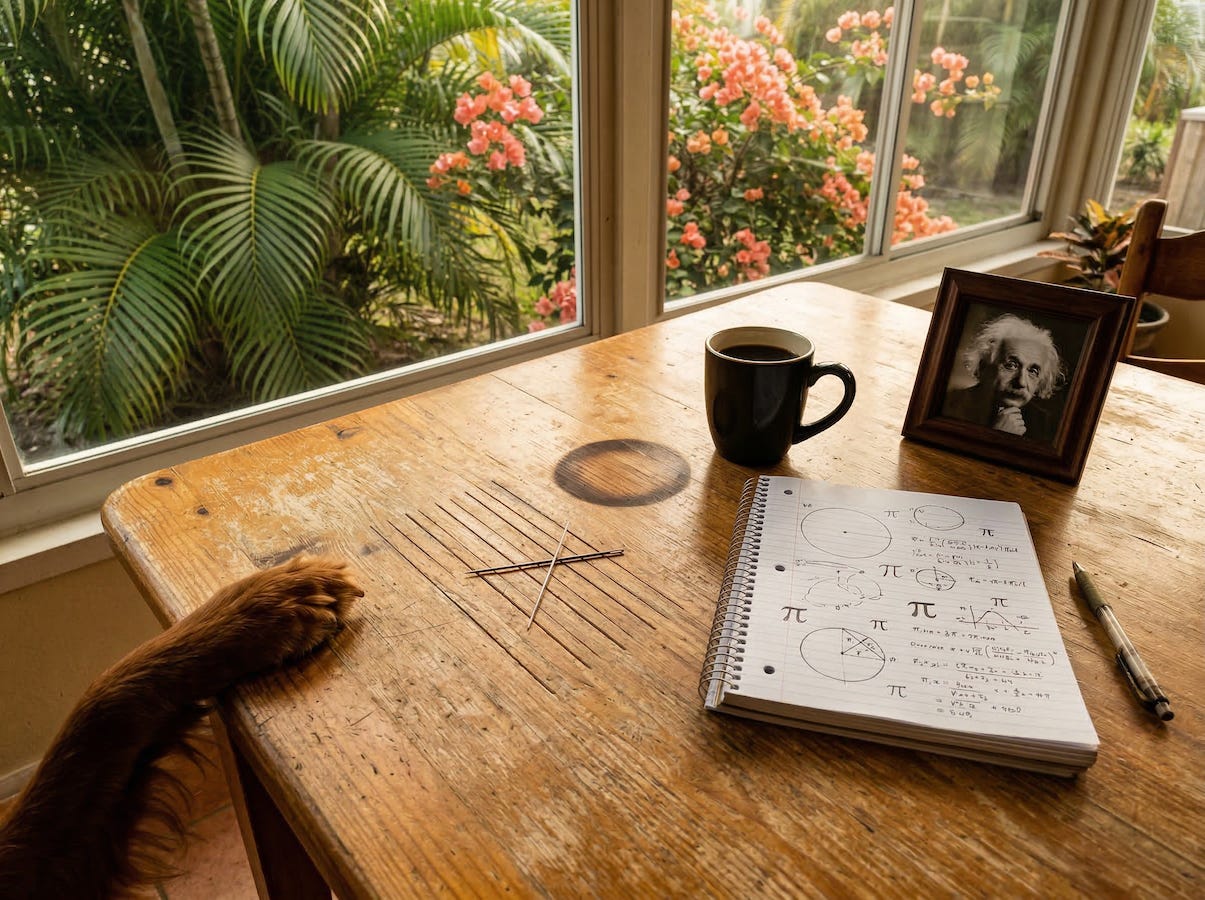
Everyone Eats Pie
Today is March 14th, and if you spend any time online, you already know what that means. Your feed is full of circle jokes, memorization contests, and photos of pie. Teachers are running classroom activities. Engineers are posting memes. The hashtag is trending, as it does every year, because 3.14 lines up neatly with the date, and we love a good excuse to celebrate something geeky with baked goods.
My own celebration is modest: a single Scottish shortbread cookie with my morning coffee, Pi adjacent at best, since diabetes took actual pie off the table years ago. The cookie is rectangular, which feels like a betrayal of the holiday’s geometry, but it’s buttery and warm, and I am not complaining.
What almost nobody mentions is that today is also Albert Einstein’s birthday. Born March 14, 1879, in Ulm, Germany, the man who reshaped our understanding of space, time, and gravity shares a calendar date with the most famous constant in mathematics. The coincidence is well documented, yet it barely registers amid the pie photos and digit-recitation videos. Almost no one notices Einstein’s birthday on Pi Day, which is fitting, because we keep finding Pi in places we never thought to look.
The Uninvited Guest
Most of us first met Pi in a geometry classroom, where it lived inside circles. Circumference equals Pi times diameter. Area equals Pi times the radius squared. Reasonable enough. A number about circles should appear in problems about circles.
The strange part is where else it appears.
In 1733, a French naturalist named Georges-Louis Leclerc, Comte de Buffon, posed a question that had nothing to do with circles. Imagine a floor made of parallel wooden strips, all the same width. Drop a needle onto the floor. What is the probability that the needle crosses one of the lines between strips? Buffon published his solution in 1777, and the answer involves Pi. No circles in the problem. No arcs, no radii, no diameters. Just a needle, a wooden floor, and gravity. Drop enough needles, count the crossings, and you can estimate Pi from the results. The number shows up uninvited, like a guest who wasn’t on the list but somehow knows everyone at the party.
It shows up in rivers, too, though this one comes with an asterisk. In 1996, the Cambridge earth scientist Hans-Henrik Stølum published a paper in Science arguing that the average sinuosity of rivers, the ratio of a river’s actual winding length to the straight-line distance from source to mouth, approaches Pi. The theoretical mechanism is compelling, and Einstein himself was the first to describe it: the slightest curve in a river creates faster currents on the outer bank, which erodes more soil, deepening the curve and accelerating the current further. Left unchecked, the river would loop into absurdity. The corrective is that extreme loops double back on themselves and short-circuit, leaving behind oxbow lakes. The balance between these two forces, Stølum argued, produces an average ratio of roughly 3.14.
Later efforts to replicate that exact average with crowdsourced data have fallen short. The actual ratio may be closer to 1.94 than to 3.14. Whether the rivers are truly converging on Pi or whether we are seeing what we want to see in the data remains an open question, and I will come back to it, because it matters for more than hydrology.
Pi also appears in the Heisenberg uncertainty principle, one of the foundational equations of quantum mechanics, through the reduced Planck constant. It appears in the normal distribution, the bell curve that governs everything from test scores to manufacturing tolerances. It threads through Euler’s identity, the equation that mathematicians routinely call the most beautiful in all of mathematics, connecting Pi with the imaginary unit, the base of natural logarithms, and the numbers one and zero in a single, improbable relationship.
A number about circles, it turns out, is a number about everything, or at least about far more than we expected when we first learned to calculate the area of a round swimming pool.
Was It Always There?
Here is where the essay takes a turn that a math column wouldn’t, because the question Pi raises is ultimately about the nature of reality, and that is a question that belongs as much to philosophy and spirituality as to mathematics.
Was Pi always woven into the fabric of things, waiting for us to notice? Or did we construct it, an artifact of the mathematical language we invented to describe the world?
This is the old debate between mathematical realism and mathematical constructivism, and I have no intention of settling it over breakfast. What interests me is that the question itself sounds remarkably like the questions people ask about meaning, about purpose, about God. Is there a pattern running through everything, independent of whether anyone observes it? Or do we impose pattern on the chaos because our brains are wired to find signal in noise?
I know which side I lean toward, because I catch myself doing it. When I write textbooks, I structure every chapter with an odd number of sections (three, five, seven), each section with an odd number of subsections, each subsection with an odd number of paragraphs. The logic is grounded in research on how people process and remember information: collections of three to seven items, with a rhythm that sets up expectations. Readers feel the structure before they can name it. They sense when the next beat is coming, and the architecture carries them forward. I impose this framework deliberately because I believe it helps readers learn. Whether the organizing principle is “in” the material or whether I am laying it on top like scaffolding is a question I have never fully resolved. Like Pi and the rivers, my structure is an approximation. I aim for the odd-numbered pattern and usually land close, but the material sometimes pushes back, and I let it. The framework is a guide, a tendency, a gravitational pull. It is rarely exact.
The river debate is a perfect miniature of this larger question. If the average sinuosity of rivers truly converges on Pi, then something extraordinary is embedded in the physics of flowing water, something that connects a meandering river in the Siberian tundra to the formula for the area of a circle. If the average is closer to 1.94, then we were reaching, finding what we hoped to find, because the story was too beautiful to resist.
I am not sure it matters which answer is correct, and I recognize that a mathematician might object to that sentence. What I mean is that either answer teaches something worth learning. If the pattern is real, then paying attention to the world rewards us with glimpses of deep structure we did not design and cannot fully explain. If the pattern is imposed, then paying attention to ourselves reveals how powerfully our longing for coherence shapes what we perceive. Either way, the practice is the same. Look closely. Notice what is actually in front of you. Be honest about whether you are observing or projecting.
That practice, it seems to me, is as central to a spiritual life as it is to a scientific one.
The Part We Don’t Need
Here is where the numbers become genuinely astonishing, and where the spiritual parallel sharpens.
NASA’s Jet Propulsion Laboratory uses 15 decimal places of Pi. Fifteen. That is enough precision to navigate spacecraft across billions of miles of interstellar space. Marc Rayman, who served as chief engineer for JPL’s Dawn mission, once explained the math this way: if you calculated the circumference of a circle with a radius stretching to Voyager 1, our most distant spacecraft, using Pi rounded to the 15th decimal place, you would be off by about 1.5 inches. On a circle more than 78 billion miles around, your error would be smaller than the length of your little finger.
If you extended the exercise to the entire observable universe, a circle with a radius of 46 billion light-years, you would need 37 decimal places of Pi to calculate its circumference to the accuracy of a single hydrogen atom.
Thirty-seven digits. The entire universe, accurate to an atom.
We have calculated 314 trillion. As of December 2025, a team at StorageReview ran a single Dell server for 110 consecutive days to push past 314 trillion decimal places, breaking the previous record of 300 trillion set just months earlier by Linus Media Group and Kioxia. The 314 trillionth digit, for what it’s worth, is a 5.
Every one of those digits beyond the 37th is, in any practical sense, unnecessary. No engineering project, no space mission, no physics calculation will ever require them. The engineers know this. The mathematicians know this. They keep calculating anyway.
Why?
The explanations usually involve testing computational hardware, benchmarking algorithms, and pushing the limits of storage technology. Those explanations are true and completely insufficient. People do not run a single server for 110 uninterrupted days just to test a hard drive. They do it because the digits never end, and something in the human spirit responds to that. The quest is the point. The incompleteness is the invitation.
I recognize that impulse. It is the same impulse that keeps someone meditating after twenty years of practice, knowing they will never achieve permanent enlightenment. The same impulse that keeps a person returning to prayer even when the heavens feel silent. The same impulse that keeps a marriage alive across decades, tending a connection that will never be “finished,” because a living relationship does not have a final decimal place.
The Practice is the Point
There is a line from the Talmud that I return to often, though I am neither Jewish nor a Talmudic scholar: “You are not required to finish the work, but neither are you free to abandon it.” Rabbi Tarfon said this, or is credited with saying it, and it appears in Pirkei Avot, the Ethics of the Fathers.
Pi is that line made mathematical. It will never terminate. It will never repeat. Every digit computed opens onto another digit, forever. The people who compute those digits know, with absolute certainty, that they will never reach the end. They continue anyway, because the pursuit of something inexhaustible is itself a meaningful act.
I think most spiritual traditions arrive at this insight eventually, though they use different language for it. Zen Buddhism frames the journey as the destination. The Christian mystics speak of an infinite God who can be approached but never fully comprehended. The Sufi poets write about a Beloved who is always arriving and never arrives. Even secular mindfulness, stripped of all religious language, teaches that the practice is the practice. You do not meditate to graduate from meditation.
When we look at Pi, this ancient insight takes a surprisingly concrete shape. Here is a number. It is infinite. It is real. It is useful long before you reach the end. Nobody is confused about whether the end exists. There is no debate, no crisis of faith, no existential anxiety about it. The mathematicians accept that it is infinite and get to work.
I sometimes wonder whether the rest of us could learn something from that posture. The spiritual questions we carry (about meaning, about purpose, about whether any pattern holds things together) may have no final answers. That does not make them empty questions. It makes them infinite ones. Infinite questions, like infinite numbers, can be genuinely useful long before anyone reaches the end.
What Hides in Plain Sight
This month’s theme in my weekly column is The World Before You, and the question running beneath all four weeks is deceptively simple: What are you paying attention to?
Pi has been in front of us for millennia. Archimedes approximated it in the third century BCE using polygons inscribed inside circles. The Babylonians used a rough estimate more than a thousand years before that. Pi was always there, in every wheel, every orbit, every ripple spreading across water. We found it in the wooden floorboards of an eighteenth-century French parlor when Buffon dropped his needle. We may yet find it in the bends of every river on Earth, though we are still arguing about that one.
Einstein was born on this day 147 years ago. He would later write that the most incomprehensible thing about the universe is that it is comprehensible, that the world yields to investigation, that those who look carefully enough find pattern and structure waiting beneath the surface. He spent his life paying attention to things other people walked past, and the attention paid off in ways that rearranged our understanding of reality.
I am not comparing my Saturday morning with Watson and Sherlock to Einstein’s annus mirabilis. I am making a smaller, humbler point. The practice of paying attention, whether to numbers, to rivers, to the person sitting across the breakfast table, is the practice. It is inexhaustible, like Pi. It rewards you long before you reach the end, which you never will.
Today, if you eat a slice of pie, or share a Pi joke, or recite as many digits as you can remember, you will be joining a tradition that stretches back centuries. You will be celebrating a number that never finishes, that hides in places no one expected, and that remains genuinely useful even though we will never fully know it.
That sounds like a description of something more than a number. It sounds like a description of almost everything worth pursuing.
📜 Essays on meaning, connection, and purpose from Spirituality Today.