

This week’s Music column explores The Part You See within February’s theme of The Courage to Connect. Rush drummer and lyricist Neil Peart wrote “Limelight” as an admission that the most visible person in the arena was also the most determined to remain unseen. His struggle with fame illuminates a tension we all recognize: the distance between what we present and who we are.
🎺 The Shy Man Behind the Kit
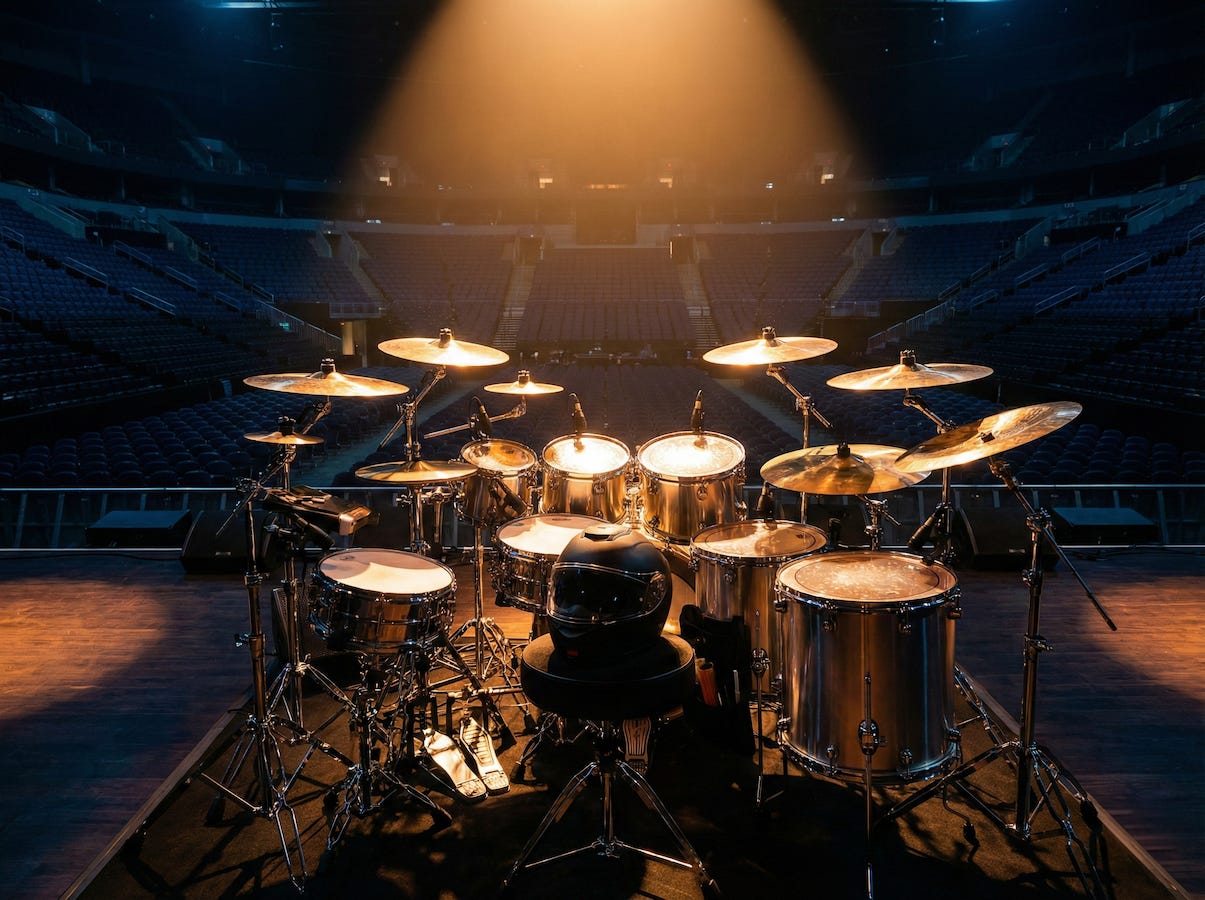
Neil Peart had a problem most musicians would envy. By 1981, the great Canadian band Rush had gone from playing half-empty clubs in Toronto to filling arenas across North America. The albums kept selling. The crowds kept growing. The man behind the drum kit, the one writing the lyrics that gave the band its intellectual spine, wanted nothing more than to disappear.
This was the paradox at the center of Rush. Peart was the primary lyricist for one of the most visible rock acts in the world, yet he described himself simply as “a shy man.” He avoided interviews. He let his bandmates, vocalist and bassist Geddy Lee and guitarist Alex Lifeson, handle the press obligations and fan meet-and-greets. Between tour stops, he traveled alone on his motorcycle, riding through small towns and eating at truck-stop diners where nobody recognized him. On stage, he was the Professor, commanding one of rock’s most elaborate drum kits. Off stage, he was a man who checked into hotels under false names because strangers on the street made him tense.
He addressed that tension the only way he knew how. He wrote about it.
🎙️ A Lake in the Mountains
“Limelight” emerged during the sessions for Moving Pictures, Rush’s eighth studio album, recorded at Le Studio in the Laurentian Mountains of Morin-Heights, Quebec, in the autumn of 1980. The remote location suited the trio. Tucked beside a lake in the foothills, Le Studio offered isolation and focus, a place where the music could take priority over everything else. Producer Terry Brown, who had worked with Rush since 1975, helped shape the sessions across roughly ten weeks of recording and mixing.
The track had already been road-tested. During a handful of warm-up shows in September and October 1980, Rush performed “Limelight” and “Tom Sawyer” for the first time, refining the arrangements before entering the studio. By the time the tape rolled, they knew what they had.
Lifeson’s opening guitar riff is one of the most recognizable in progressive rock. He played it on a modified Fender Stratocaster he called the “Hentor Sportscaster,” equipped with a Floyd Rose vibrato arm that gave his sustained notes their distinctive shimmer. The solo that follows remains Lifeson’s personal favorite. “It has a certain tonality I just love,” he told Music Radar. “It really conveys the pathos of the song.”
🌍 The Gilded Cage
What makes “Limelight” remarkable is what Peart chose to reveal. He drew from Shakespeare’s “All the world’s a stage” monologue in As You Like It, framing every public interaction as a kind of performance. He wrote about feeling “totally alienated by the gilded cage” of celebrity, about the impossibility of treating a stranger’s enthusiasm as genuine friendship. He was writing, in other words, about the gap between what the audience sees and the person behind it.
Years later, he reflected on why “Limelight” endured. “That was an attempt on my part to explain myself as an introvert,” he told interviewers. “It’s been remarkable over time how many young musicians have come up to me and told me what that song means to them when they faced the same transition in their life.”
Released as the lead single from Moving Pictures in February 1981, “Limelight” reached No. 4 on Billboard’s Mainstream Rock chart and No. 55 on the Hot 100. The album itself peaked at No. 3 on the Billboard 200 and eventually went quadruple platinum. More important than the chart positions, those four and a half minutes of confession changed how listeners perceived Rush. A band known for twenty-minute epics about dystopian futures was now writing about something achingly personal.
💫 The Part You Choose
“Limelight” became a staple of Rush’s live performances for decades. It appeared in films, video games, and even the intro for CBC’s Hockey Night in Canada after Rush’s Rock and Roll Hall of Fame induction in 2013. In 2010, it was one of five Rush compositions inducted into the Canadian Songwriters Hall of Fame.
Peart died on January 7, 2020, after a quiet battle with brain cancer. He was sixty-seven. True to form, the family kept the news private for several days before making it public. Even in death, he controlled what the world saw.
The rest of us make the same calculations in quieter rooms. We choose the photo we post, the story we tell at dinner, the parts of ourselves we offer, and the parts we hold back. Peart understood that this deliberate editing is itself a kind of honesty. It is the craft of living among other people while remaining, somehow, intact. The part you see is chosen. The part you do not see is where the person actually lives.
Rush performing “Limelight” live at the Montreal Forum on March 27, 1981. I was there 😊
💡 Did You Know?
Song: “Limelight”
Artist: Rush
Songwriter(s): Neil Peart (lyrics), Geddy Lee and Alex Lifeson (music)
Album: Moving Pictures (1981, Anthem/Mercury Records)
Recorded: Le Studio, Morin-Heights, Quebec, October–November 1980
Producer: Rush and Terry Brown
Signature Features: Lifeson’s Floyd Rose vibrato guitar solo (his self-described favorite); Peart’s autobiographical lyrics paraphrasing Shakespeare’s “All the world’s a stage”
Charts: No. 4 on Billboard’s Mainstream Rock chart; No. 55 on Billboard Hot 100; No. 18 in Canada
Cultural Impact: Featured in films including I Love You, Man and Fanboys; used as CBC’s Hockey Night in Canada intro (2013); playable in Guitar Hero and Rock Band
Legacy: One of five Rush compositions inducted into the Canadian Songwriters Hall of Fame (2010); Rush inducted into Rock and Roll Hall of Fame (2013); Moving Pictures ranked No. 379 on Rolling Stone’s “500 Greatest Albums of All Time” (2020)
👉 Try This
This week, pay attention to your own editing. Notice one moment where you choose what to reveal and what to hold back, whether in a conversation, a text message, or a photo you almost posted. Instead of judging the impulse, name it. The awareness itself is the practice.
🪞 Author’s Note
Le Studio sat in the Laurentian Mountains of Morin-Heights, Quebec, roughly an hour north of Montreal, where I grew up. If you watch footage from those recording sessions, you can see the snow piled outside the windows. I can almost smell it.
I play “Limelight” in the car before big talks. Every time. Something about that opening riff resets my nerves and reminds me why I agreed to stand in front of a room full of people in the first place. The lyrics land differently when you have been in the public eye long enough to feel the weight of it, when strangers think they know you because they have read your words, and you realize that what they know is the part you chose to show them.
Neil Peart once said he understood Pink Floyd’s The Wall entirely, that the alienation Roger Waters described was something he recognized in his own bones. I understand it too, on a much smaller scale. The wall is real. The question is whether you build it to protect yourself or to hide.
🎵 Reflections on music & meaning from Spirituality Today.
📬 Share this story with someone who has experienced living in the limelight.