

Spirituality Today continued the month on conflict and resolution by reflecting on Hiroshima and the first use of atomic weapons, marking 80 years since VJ Day.
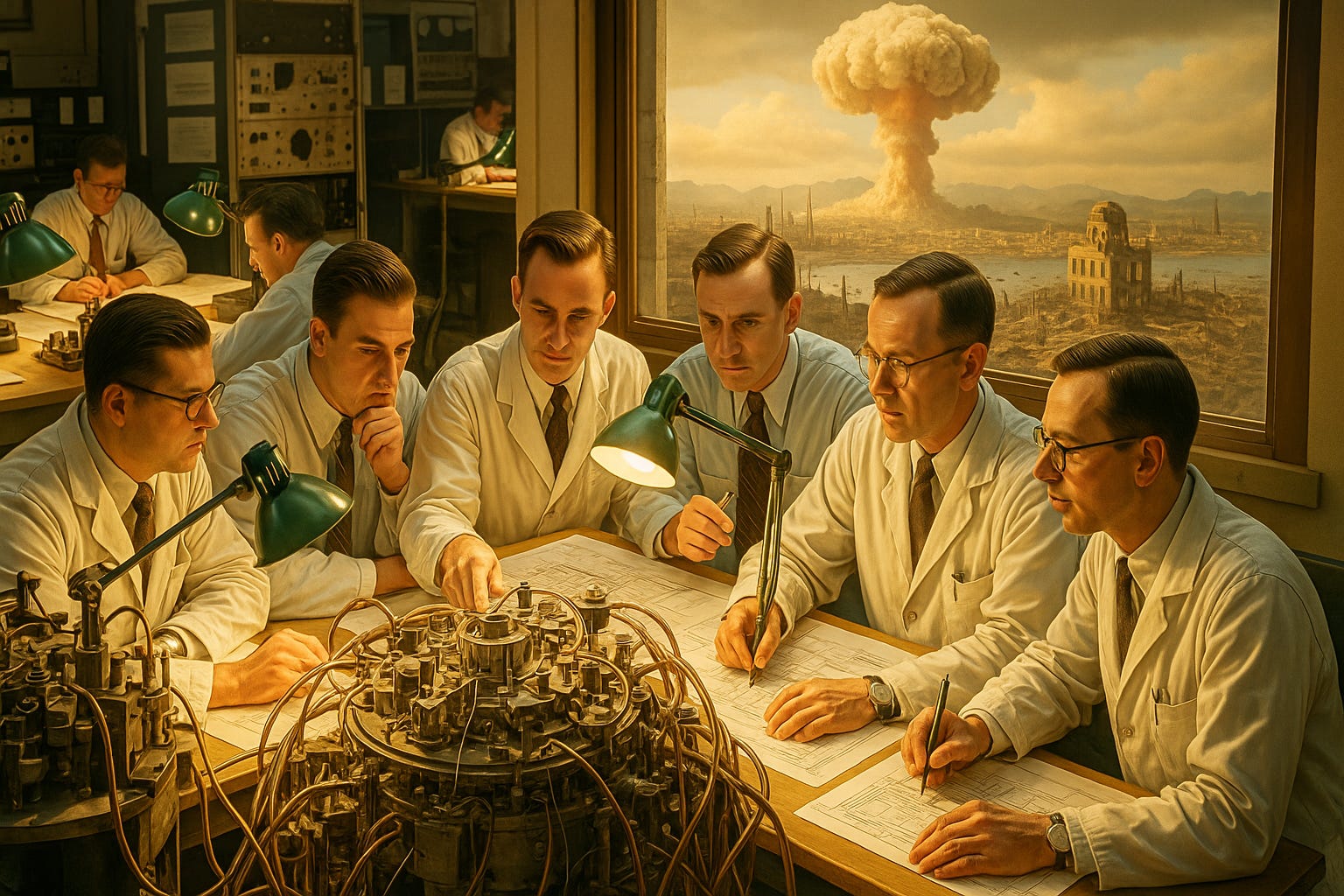
History lines up neatly this week. VJ Day stands 80 years behind us, and the great Canadian band Rush released “Manhattan Project” in 1985, forty years after 1945 and forty years before today. In 1985, 1945 felt remote, almost like a different planet; from 2025, 1985 feels close enough to touch. That shift shapes how we treat older conflicts, because time can soften edges, while careful remembrance, with names, dates, and lived accounts, helps communities keep the lessons active.
The anchor column examined the moment when conflict reached its most devastating scale. This week’s music selection explores how we preserve and process such moments through art. Rush’s “Manhattan Project” transforms historical documentation into moral reflection, showing how precise memory serves as both witness and warning.
Memory as Moral Compass
Peacemaking begins with honest memory. During my visit to Hiroshima’s Peace Memorial Park, I stood near the Cenotaph as the bell tolled at 8:15 a.m., marking the exact minute the bomb detonated on August 6, 1945. The bell rings each year during the Peace Memorial Ceremony, followed by silence and declarations for peace. The ritual’s precision gives it weight.
Forty years after Hiroshima, Rush captured this same weight in “Manhattan Project.” Neil Peart researched the wartime program extensively, crafting lyrics that read like historical documentation. The song appeared on Power Windows in 1985, an album exploring different forms of power: money, nations, technology, and belief. Released during the late Cold War’s nuclear anxieties, the track reached audiences already living under atomic shadows.
Peart organized his research into four distinct scenes, each told through different eyes: competing nations in the war’s final days, a scientist wrestling with discovery, teams gathering in desert secrecy, and the crew flying their August mission. Producer Peter Collins and the band recorded these perspectives with measured restraint, using orchestral elements from Abbey Road Studios and Andy Richards’ synthesizer programming to create atmosphere without melodrama. The writing avoids easy judgment while centering human decisions and consequences.
🎶 Screens light the room; choices light the way.
Four Witnesses to History
Peart structures the song through four vignettes, each beginning with “Imagine.” The technique creates distance for clarity, allowing moral focus without sermonizing.
First comes the wartime context. Nations race for a decisive advantage as the conflict nears its end. Competition, fear, and momentum drive decisions. Peart places listeners in rooms where urgency shapes the agenda.
     Imagine a time when it all began
     In the dying days of a war
     A weapon that would settle the score
     Whoever found it first
     Would be sure to do their worst
     They always had before
A scientist appears next, pacing the floor. This detail transforms vast technical projects into human portraits. Worry and curiosity share space in laboratories where stakes run high. The scene emphasizes agency, since specific people make choices that shape history.
     Imagine a man where it all began
     A scientist pacing the floor
     In each nation, always eager to explore
     To build the best big stick
     To turn the winning trick
     But this was something more
The third vignette shifts to the desert. Brilliant minds gather at a secret site to work with dangerous new tools. Playthings become instruments. Experiments meet the real world. Collaboration accelerates both discovery and risk.
     Imagine a place where it all began
     Gathered from across the land
     To work in the secrecy of the desert sand
     All the brightest boys
     To play with the biggest toys
     More than they bargained for
Finally, we see the Enola Gay crew on August 6. Theory becomes impact. A specific mission changes history. The precision matches Hiroshima’s record keeping, marking transformation down to the minute.
     Imagine a man when it all began
     The pilot of Enola Gay
     Flying out of the shockwave on that August day
     All the powers that be, and the course of history
     Would be changed for evermore
These four perspectives converge in the chorus, where Peart captures the moment of detonation itself:
     The big bang took and shook the world
     Shot down the rising sun
     The end was begun, it would hit everyone
     When the chain reaction was done
The Architecture of Memory
The arrangement reflects the gravity of its subject. Measured tempo, prominent vocals, and restrained guitar work against synthesizer textures typical of mid-1980s production. Peart once described the approach as a case study rather than a sermon, presenting scenes and characters while leaving moral reasoning to listeners. This was an evolution of documentary-style songwriting that Rush had tested earlier. The music serves the story without overwhelming it.
My experience at Hiroshima’s memorial connected directly to this design philosophy. Both the Peace Memorial Ceremony and Rush’s composition insist on specificity. Dates, places, and people become anchors that keep memory from drifting into abstraction. Names get added to registers. Flowers arrive. The bell sounds at 8:15 a.m., followed by an explicit commitment to peace. These details matter because precision preserves truth. The song works the same way, marking exact moments: the war’s dying days, the desert sand, that August morning.
The Point of No Return
The song’s central image names a moment after which nothing can return to its previous state. History cannot rewind. This irreversible threshold carries weight beyond its historical context. Projects at work, new technologies, even casual comments create effects that continue after intention fades. A pause before action serves everyone better than rushed victories that age poorly.
Walking past Hiroshima’s Atomic Bomb Dome toward the river, I noticed how tour groups fell quiet approaching the memorials. That quiet matched how “Manhattan Project” concludes. The song finishes without triumph, leaving room for reflection. After the final chord, listeners carry the lesson forward. Rush created something rare with this track: a rock song about nuclear weapons that respects its subject’s weight. The band avoided both glorification and preaching. They presented human choices and consequences, then trusted audiences to complete the moral equation.
This week, as we remember Hiroshima’s anniversary and reflect on conflict resolution, the “Manhattan Project” provides a framework for examining how decisions accumulate into history. The song reminds us that peace requires active memory, specific acknowledgment, and conscious choice. Every generation faces its moments of irreversible change. How we remember the past shapes how we navigate those thresholds.
💡 Did You Know?
Song: “Manhattan Project”
Artist: Rush
Album: Power Windows (1985)
Charts: Reached No. 10 on Billboard’s Mainstream Rock chart in January 1986
Signature Features: Four “Imagine” vignettes structure; documentary-style narrative approach; measured tempo with period-defining synthesizer textures; orchestral arrangements by Anne Dudley recorded at Abbey Road Studios; Peart’s extensive historical research informing the lyrics
Legacy: Stands as one of rock’s most thoughtful examinations of nuclear weapons; pioneered Rush’s documentary songwriting approach that influenced later compositions; remains a touchstone during atomic anniversaries and peace ceremonies; frequently cited as an example of progressive rock tackling serious historical subjects without preaching
💫 Try This
This week, pause before making decisions that cannot be undone. Consider the ripple effects of your choices at work, in relationships, or online. Small actions accumulate into larger patterns. What thresholds are you approaching? Take that extra moment to weigh consequences before crossing them.
🎵 Reflections on music & meaning from Spirituality Today