

On seeing Cheap Trick at the King Center in Melbourne, Florida, on March 9, 2026, and at The Forum in Montréal, Canada, on August 11, 1980.
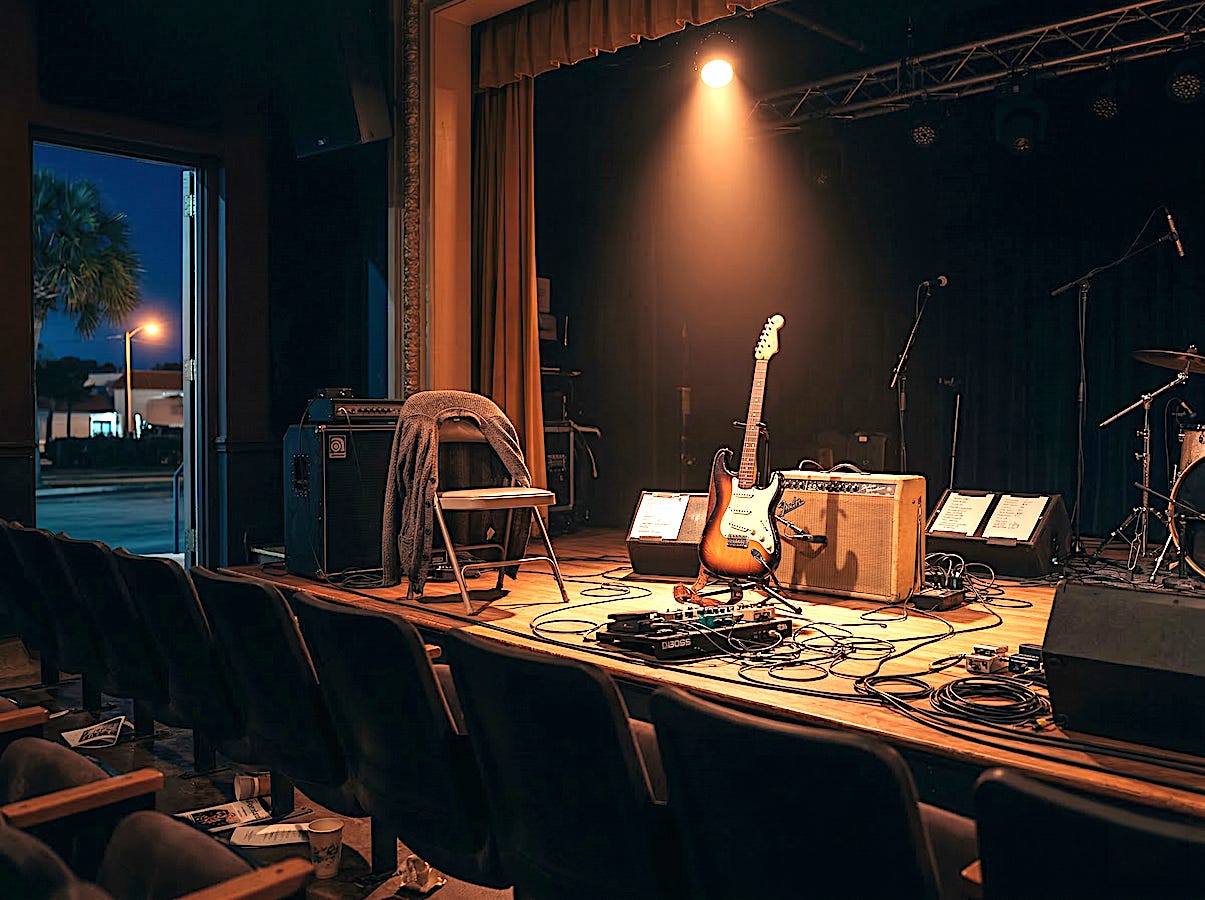
I had been looking forward to this for weeks. Cheap Trick, playing the King Center in Melbourne, Florida, on a Monday night in March. I bought the tickets the way you buy a gift for your younger self, with the certainty that the thing you loved at sixteen will still be the thing you love at sixty-one. My wife came along because I wanted to go, which is its own kind of generosity. She knew “The Flame,” and that was about it.
The King Center holds a few thousand people. I mention this because the last time I saw Cheap Trick was on August 11, 1980, at the Montréal Forum, which held 18,000, and every seat was full. I was sixteen. Montréal in summer is a city that vibrates, with joie de vivre pouring out of every café and street corner, cosmopolitan, young, and loud. The Forum was the temple of that energy, and Cheap Trick filled it. I remember thinking they were unbelievably loud, and I loved every decibel.
Forty-six years later, the lights went down at the King Center, and Rick Nielsen walked on stage.
Walked is generous. He shuffled. The man who used to bounce across stages like a kangaroo, who changed wardrobes and guitars mid-song, who played three-neck and four-neck instruments as if the absurdity were the point, now moved like someone navigating an icy parking lot. He was bent forward at the spine, a pronounced hump in his upper back, the posture of a man whose body has been arguing with gravity for seventy-seven years and losing. When he spoke between songs, the words came out slurred and halting, noticeably different from the last time I heard him. Tom Petersson, the bassist, stood off to the side wearing a hat, a cardigan, and a scarf around his neck. He looked like a man dressed for a porch rocker, not a stage. Robin Zander, the lead singer, is seventy-three and still carrying the frontman role, though carrying is doing heavy lifting in that sentence. The drummer, Daxx Nielsen, is Rick’s son, the one member on stage whose body still matched the music’s tempo.
I sat there in my seat, wearing Apple AirPods set to noise-cancellation mode, because the music I once loved for its volume had become too loud. There is a line from The Pursuit of Happiness, the Canadian band whose songs keep finding me at the right moments: you used to like loud music, but you don’t like it anymore because it’s too loud. I had become the person Moe Berg wrote about.
Something had gone wrong with my evening, and I couldn’t immediately name it.
The Forum, August 1980
The Montréal Forum smelled like cold concrete, cigarette smoke, and stale beer. The arena was so packed that eighteen thousand people were generating their own weather system. I was sixteen, and everything was enormous. The stage seemed impossibly far away and impossibly bright, and Rick Nielsen was everywhere on it, leaping, spinning, throwing guitar picks into the crowd like confetti, swapping instruments between songs and sometimes during them. He had a five-neck guitar that he played for the sheer theater of it. His clothes changed. His energy never did.
Cheap Trick had broken through two years earlier with their live album recorded at the Budokan arena in Tokyo. “I Want You to Want Me” and “Surrender” were on the radio constantly. They were a band that understood spectacle, that knew the distance between a good rock concert and a great one is the willingness to be ridiculous with absolute conviction. Nielsen was the engine of that ridiculousness, a man who looked like he had wandered in from an accounting office and then played guitar as if the building were on fire.
I loved it. I loved the volume, the chaos, the sweat on the concrete floor. I was sixteen in a sold-out arena in one of the most alive cities in North America, and the noise was the whole point. The show was so memorable that I etched “Cheap Trick” on the back of my jean jacket to wear at school later, joining “Black Sabbath” as doodles of honor.
I carried that recording in my head for forty-six years. I didn’t know, sitting in the King Center with my noise-cancelling earbuds, that the recording was what I had actually come to hear.
The Two Audiences
The people around me at the King Center were having a wonderful time. They sang along to every chorus. They cheered when Nielsen held up a guitar. They stood and clapped and hollered as if they were watching the band I remembered rather than the band that was actually on stage.
Many of them were dressed for 1980. Long hair that had thinned but not been cut. Concert tees from tours that predated the internet. Jeans that fit differently than they used to. Some were dressed as if their closets had been sealed in amber sometime during the Reagan administration, and they had simply opened the door that morning and put on whatever was closest. A few were visibly inebriated, which helped with the time travel. Their homes, I suspected, might look the same way: a room somewhere with posters and albums and a turntable, a small museum of who they used to be.
I recognized myself in them, and that was uncomfortable.
I had bought a ticket to this concert for the same reason they had. I wanted to feel something from 1980. I wanted the Forum back, the volume, the version of myself that didn’t need noise cancellation. The difference between me and the man in the vintage tee shouting the words to “Dream Police” wasn’t that I was more clear-eyed. The difference was that I felt the sadness and he did not, or he felt it too and decided to sing through it. I do not know which of us was seeing more clearly. I suspect we were both seeing exactly what we needed to see.
Don Henley captured this specific dislocation decades ago: a Deadhead sticker on a Cadillac. The symbols of rebellion absorbed into the machinery of comfort. We all go through this, and we don’t get to refuse. We watch the things that once defined us settle onto a shelf where they become decoration rather than identity.
The Keith Richards Question
Here is the part where it would be easy to say that Rick Nielsen should retire, that there comes a time to know when the show is over, that wisdom means stepping away before the audience sees you diminish. It would be easy, and it would be a bumper sticker masquerading as insight.
Because here is the other possibility. Rick Nielsen is doing exactly what he wants to do. He has been playing guitar in front of crowds since 1974, fifty-two years, more than five thousand shows. The stage may be the only place where he feels entirely like himself. The shuffling, the bent spine, the slurred speech: these may be the price of admission to the only room where he is still Rick Nielsen, lead guitarist, and not Rick Nielsen, old man in a house somewhere. Keith Richards has said as much about his own life, that he expects to do this until they wheel him out in a box. A few years ago, Phil Collins sat in a chair under the lights with Genesis during their final reunion, unable to play drums, barely mobile, still there. The feeling I had watching three members of Cheap Trick, especially Nielsen, was the same feeling I had watching Collins: a complicated mix of admiration and sorrow, tangled so tightly I couldn’t pull them apart.
Who am I to say this is the wrong path? If the stage is his garden, and the guitar is his morning practice, and the setlist he has played a thousand times is the daily ritual that gives his life structure and meaning, then he is doing what any of us hopes to do. He found the thing he was made for, and he refused to leave it. That is not delusion. It might be the deepest kind of faithfulness.
Rush, the Canadian prog-rock band I saw at that same Montréal Forum around 1982, is about to test this question from the other direction. After Neil Peart died in 2020, Geddy Lee and Alex Lifeson said they were done. They stopped. They grieved. Then they spent years quietly deciding whether to return, and announced a 2026 reunion tour with a young German drummer named Anika Nilles. Their return is deliberate, framed as tribute, limited in scope. Peart once wrote that everybody needs an echo, some affirmation to know they are not alone. Rush stopped sending the signal and then carefully chose to send it again. Cheap Trick never stopped sending. I don’t know which approach honors the music more. I may find out this summer if I see Rush play, forty-four years after the Forum, and feel whatever I feel then.
Who Are You Now?
I know something about this question because I had to answer it myself.
For twenty years, I was Dr. Tilley, professor of computer science and software engineering. That wasn’t a job description. That was an identity. When someone at a dinner party asked what I did, the answer came out as a single smooth sentence that located me in the world: I am a professor. The title preceded me into rooms. It followed me out. It structured my calendar, my social life, my sense of where I stood among other adults.
When I retired, that sentence stopped working.
The question didn’t change. People still asked what I did. The difference was the pause before I answered, the half-second of recalibration where the old sentence rose out of habit and I had to catch it before it left my mouth. What replaced it wasn’t a single sentence. It was a list: minister, columnist, speaker, writer, the kind of answer that sounds interesting at parties and felt, for a while, like scattered fragments of a person who used to be whole. Everyone who has left a long career knows this pause. The surgeon whose hands develop a tremor. The executive who retires and discovers that the corner office was the self. The athlete whose body decides for them, publicly, in front of cameras, which is its own particular cruelty.
The identity crisis of retirement isn’t about losing a paycheck. It’s about losing the answer to the question “Who are you?” and having to build a new one from materials you’re not sure you have.
I built mine. It took time. Melbourne, Florida, is a long way from Montréal, and I didn’t get here in a straight line. I became a minister, which required learning to speak in terms of meaning rather than code. I started a weekly column, which required learning to write for readers who didn’t care about software architecture. I created a synthwave duo called Gap+Tran, which required me to learn skills I had never used in my academic career. Each of these was a new life, or at least a new room in the same life, and the accumulation of rooms is what eventually made the house feel full again.
This is where I differ from Rick Nielsen, and I want to be careful about how I say it, because I’m not arguing that my path is better. I diversified. He specialized. I learned new songs. He kept playing the ones he has played since 1978. When the professor identity ended, I had other identities ready, some already built, some under construction. If the guitarist identity were taken from Nielsen, I’m not sure what would remain, and that thought is both terrifying and, from his perspective, possibly irrelevant. He hasn’t lost it. He is still out there, shuffling to the microphone, playing “Big Eyes” for the umpteenth time. The guitar is still in his hands.
If we lived to three hundred, would he still be playing “I Want You to Want Me” two centuries from now? Or would he, eventually, set down the guitar and discover who else he might become? We already live this experiment. It’s compressed into eighty-five years instead of three hundred. The question is whether we notice the transitions and move with them, or grip the one thing we know and hold on until our fingers give out.
Surrender
The encore opened with “Surrender,” and I caught the irony before the first chorus.
Surrender. The track Cheap Trick wrote in 1978, when they were young and the joke was about teenagers and their embarrassing parents. Mommy’s all right, Daddy’s all right, they just seem a little weird. The parents in the lyric are playing Kiss records and rolling around on the couch, mortifying their children by refusing to act their age. When it was written, those parents were the older generation, the ones who should have known better, the ones the teenagers were laughing at.
Now the men singing it are older than those parents ever were. They are grandparents, or old enough to be. They have become the embarrassing adults in their own anthem, and no one up there seems to have noticed. The lyric is frozen in 1978. The bodies performing it are in 2026. The audience, my age, the same generation that once identified with the teenagers, now occupies the parental role that the song mocked. We are all on the wrong side of our own chorus.
Surrender, indeed. To time, to circumstance, to the slow rearrangement of everything you thought was permanent. The title itself felt like an instruction, and I sat in the King Center thinking that surrender might be the only honest option available, if only anyone performing or watching were willing to admit it.
There was one moment, though. During “Need Your Love,” a longer, more hypnotic track from the early catalog, something shifted. The pulse of it builds slowly, and for three or four minutes, I stopped seeing the men in front of me and heard only the music. I think I was listening to my own inner recording of them rather than the sound coming through my noise-cancelling earbuds, the version stored in the same place that stores the Forum and the cigarette smoke and the feeling of being sixteen in a city that never slept. The echo was loud enough to drown out the present, just for a moment. It still moved me.
Then the lights came up, and they were old again, and so was I.
Dark Roads Home
We drove home through the Florida night and almost immediately hit an unexpected road closure. Detour signs sent us into unfamiliar neighborhoods, dark streets with no landmarks, the GPS recalculating every few hundred yards. My wife, who had been patient all evening with music that wasn’t hers and volume that was too much, sat quietly while I navigated roads I had never seen.
I thought about the concert. I thought about Montréal. I thought about how strange it is to carry a forty-six-year-old recording in your head and then walk into a room where the original band is playing the same songs, and the music is the same, and nothing else is. An echo is the original sound, changed by distance and by every surface it has bounced off on its way back to you. You can recognize it. It’s also not what it was.
I do not know whether Rick Nielsen should stop. I do not know whether the people in the audience, dressed for a decade they can never re-enter, are deluding themselves or simply choosing joy in the most direct way available to them. I do not know whether my sadness that evening was wisdom or just the particular grief of a man who wanted to be sixteen again and was reminded, firmly, that he cannot be.
What I know is that I didn’t play the same song for forty-six years. I learned new ones. I moved from Montréal to Melbourne via a rather circuitous route. Six cities, four careers, each one requiring me to answer “Who are you?” all over again. I traded the Forum for the King Center, the lecture hall for the pulpit, the academic paper for the weekly column, the electric guitar for the synthesizer. Whether that makes me more evolved or simply more restless, I can’t say. I know my path. I do not begrudge Rick Nielsen his.
We found our way home eventually, the way you always do in Florida: a side road that connects to a road you recognize, and then the familiar turn, and then the driveway. The music was still in my head—the same set, from the same band, playing across forty-six years of distance. Fading, recognizable, changed.
A distant echo, still reaching me. Testing whether anything comes back.
📜 Essays on meaning, connection, and purpose from Spirituality Today.