

TL;DR: Digital platforms have created new formats for public apology, from Notes app screenshots to comment-section confessions. These formats often prioritize performance over repair. When the relationship matters more than the audience, the most effective technology is usually the oldest one: a private phone call.
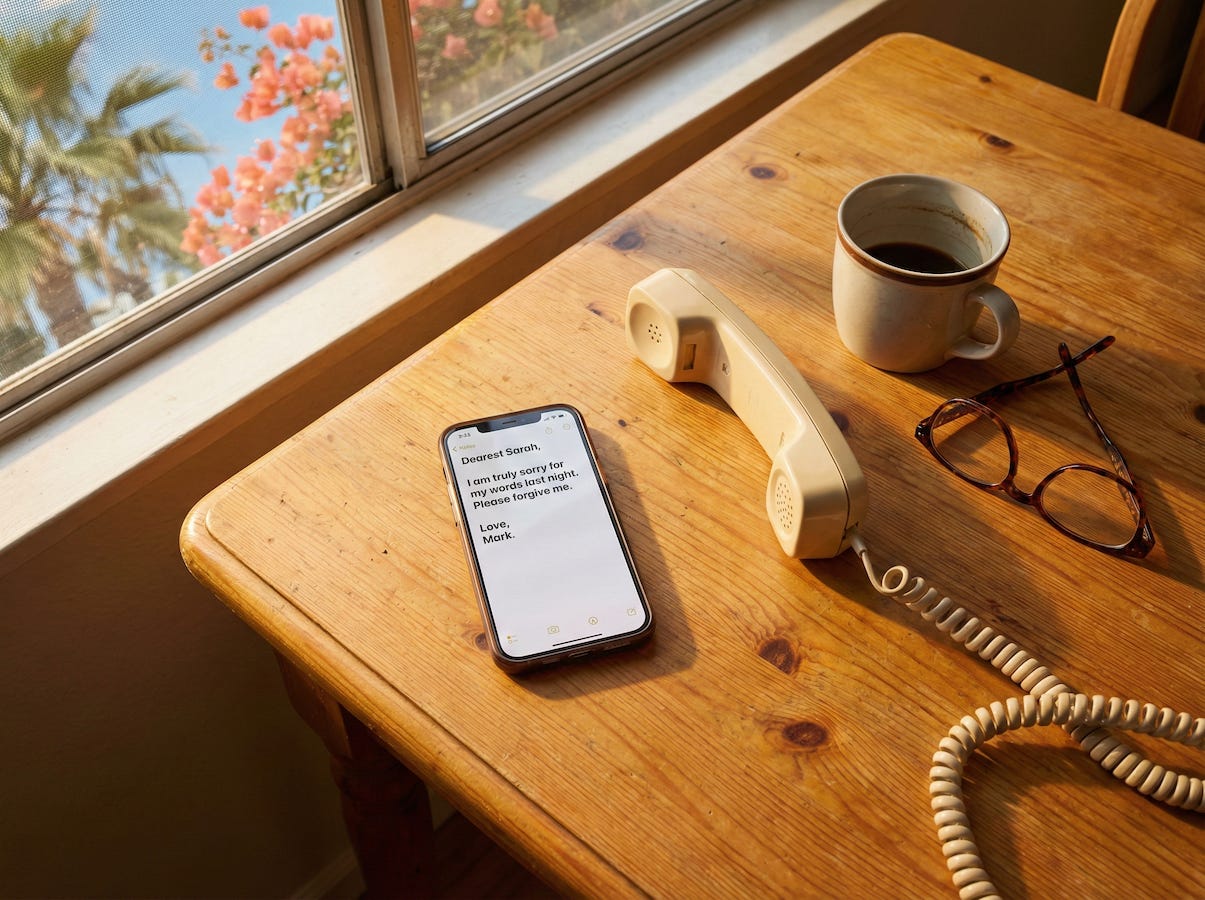
📱 The Screenshot Heard Round the World
You have seen the format. A celebrity, a brand, an influencer posts a screenshot of their iPhone Notes app: black text on a pale yellow background, carefully paragraphed, posted to Instagram or X. The Notes app apology has become its own genre, so recognizable that it has spawned countless parodies and a term in the cultural lexicon.
The format became widespread starting around 2015, when Ariana Grande’s Notes-style iPhone apology after a widely covered incident at a donut shop became a high-profile example. By 2019, it was dubbed the “Year of the Celebrity Notes App Apology” by outlets such as Vogue. Saturday Night Live mocked the trend in a 2021 sketch, portraying the Notes app as the place to go when you need a lame apology decades late.
The irony is thick. A format chosen to signal sincerity has become a signal of calculation. When a Notes app screenshot appears in your feed now, the first response is rarely “how brave.” It is usually “what did they do?”
There is something worth noticing here. We have built platforms designed for broadcasting, performing, and reacting. We have yet to build one designed for mending.
🏛️ Architecture Shapes Behavior
Every platform nudges us toward certain kinds of communication. X rewards speed and sharpness. Instagram rewards aesthetics. LinkedIn rewards professional polish. None of them reward the slow, uncertain, unglamorous work of saying “I was wrong” to a specific person.
Consider what platforms offer for conflict. X has a block button and a mute button. Instagram lets you restrict comments on your posts. Facebook has “Take a Break,” which hides someone’s posts from your feed after a breakup. These are tools for distance, not for return. They help us manage the aftermath of rupture. They offer nothing for the rupture itself.
This shapes behavior in predictable ways. Research from Amit Kumar at the University of Texas at Austin and Nicholas Epley at the University of Chicago, published in the Journal of Experimental Psychology, found that people consistently chose text over phone calls because they expected calls to feel awkward. They were wrong. Participants who actually made calls felt significantly more connected than those who texted. The voice itself, even without visual cues, seemed integral to bonding. The medium we choose out of comfort is often the one least likely to accomplish what we need.
🛠️ When to Take It Offline
The simplest rule for digital repair is one question. Is this apology for the person I hurt, or for everyone watching?
If the answer is them, the tool should match. A text message is usually better than a public post. A phone call often does more to restore connection than a text. A face-to-face conversation, when possible, tends to be better than all of them. Each step closer to real-time, private exchange strips away the audience and returns the focus to the relationship.
There are exceptions. Public harm sometimes requires public acknowledgment. A company that mistreats customers, a leader whose failure was visible to everyone. In those cases, the public statement addresses the public injury. Even then, the people most affected usually need a private conversation too. The statement opens the process. It does not complete it.
For personal relationships, the calculus is simpler. If you wouldn’t say it to the person standing in front of you, reconsider posting it. If you have revised the message more than twice, you are probably writing for an audience. Pick up the phone.
💡 Did You Know?
Research from Binghamton University found that text messages ending with a period are perceived as less sincere than those without one. The punctuation mark, neutral in every other context, reads as cold or curt in a text. Our brains are searching for tone in a medium that strips it away, and they will find signals in the smallest details, even a dot.
👉 Try This
The next time you owe someone an honest conversation, notice which platform you reach for first. If your instinct is to text, consider calling instead. If your instinct is to post, consider messaging privately. Move one step closer to real-time, one step further from the audience. Repair works best when only the people involved are in the room.
🤖 Reflections on technology & society from Spirituality Today