

This week opens The World Before You, our March theme exploring what we see when we finally look up. The first topic, What We Walk Past, asks what’s hiding in plain sight in the places we think we know best. In this Compass column, a Brevard County reader discovers that a visiting mother-in-law from Ohio sees more of the Florida landscape in five days than the reader has seen in years.
💬 Dear Compass,
My mother-in-law visited from Ohio last week. Five days. I love her, and I was looking forward to it, which makes what happened more embarrassing.
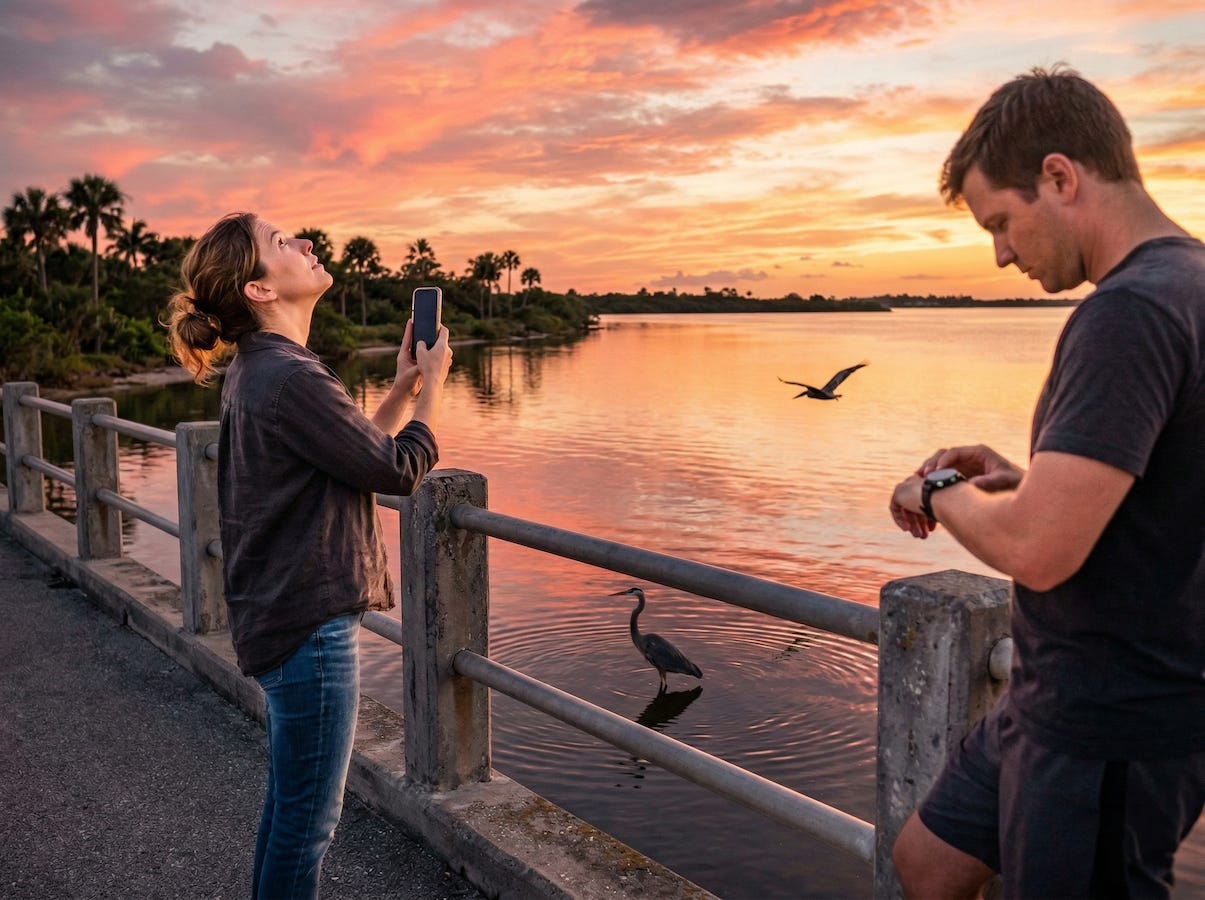
She wanted to walk the causeway every evening. Fine. Except she stopped every thirty seconds. A great blue heron standing in the shallows. A pelican diving into the Indian River. The way the sunset turned the clouds pink and orange over the water. She pulled out her phone for each one. “Look at THAT,” she kept saying. I kept looking at my watch.
By day three, I was genuinely annoyed. We were late to dinner twice. I caught myself thinking, “It’s just a heron. They’re everywhere.”
On her last evening, she stood at the railing, watching the sun go down, and said, “I can’t believe you get to see this every day.” I didn’t know what to say, because the truth is, I don’t see it. I haven’t in years. I drive over the causeway to get to the other side. The lagoon is just the thing between here and there.
She went home to Ohio. I drove to work Monday morning, and the water was doing exactly what it always does, and I realized I had no idea what that was anymore.
🤔 How do you get back what you’ve forgotten to see?
— Blinders in Brevard
🧭 Dear Blinders,
Your mother-in-law gave you a gift more valuable than she knows. She showed you your own life through fresh eyes, and the fact that it stung means you’re already paying attention to the gap.
What you’re describing has a name in psychology: habituation. We adapt to repeated stimuli. The brain, in its efficiency, files familiar beauty under “handled” and moves on to threats and tasks. This is useful for survival. It is terrible for wonder.
You haven’t lost the ability to see what’s out there. You’ve built a layer of speed over it. The beauty is still there. You started driving faster.
Try this. Once this week, take the causeway with nowhere to be: no dinner reservation, no errand on the other side. Just drive, or better yet, park and walk. Bring your phone if you want, and do what your mother-in-law did. Photograph one thing that catches you. Text it to her. She’d love that, and it gives you a reason to look.
The longer practice is simpler and harder. Pick one moment in your daily commute and describe it to yourself as if you’re explaining it to someone who’s never been here. “The water is flat this morning, almost silver.” “A pelican is sitting on that piling again, facing east.” The practice takes no extra time. You’re adding one sentence of attention to a commute you already make.
Your mother-in-law is a visitor. That’s her only advantage. Visitors see everything because nothing is filed yet. You can borrow that posture without buying a plane ticket. You pretend, for thirty seconds, that you’ve never been here before.
The heron isn’t just a heron. You knew that once. You can know it again.
🧭 The Compass
🪞 Reflections for the Journey
I remember the first time I saw the Indian River Lagoon. I had just moved to Melbourne from California, and everything about Florida felt oversaturated. The sky was too blue. The birds were too big. The air smelled like salt and warm grass, and at five in the afternoon, the light turned everything gold in a way that felt theatrical, like someone had adjusted the color settings on the whole landscape.
That was years ago. Now I cross that same water on various errands, and most days I could not tell you whether it was calm or choppy, blue or gray. The causeway is a bridge between tasks. The lagoon is the gap I drive over.
Blinders in Brevard called it wallpaper, and that word is exactly right. Wallpaper is chosen for its beauty. Then it becomes invisible because it’s always there. We still love the pattern. We just forget it’s there.
The cost is quiet. Nobody announces the moment the sunset loses its hold on them. Nobody sounds an alarm when they stop feeling the awe. It happens gradually, commute by commute, errand by errand, until someone from Ohio stands at the railing and says, “Look at THAT,” and you realize you’ve been looking through it for years.
I think the issue is less about familiarity than about speed. Visitors move slowly because they have nowhere particular to go. Residents move fast because they always do. The water hasn’t changed. The birds are still there every day, standing in the shallows as if waiting for someone to notice. The difference is pace. Slow down for thirty seconds, and the wallpaper starts to resolve back into what it always was.
This month, in The World Before You, we’re exploring what happens when we look up from our routines and discover what’s been right in front of us. Blinders already had everything she needed. She just had to stand still on a familiar bridge for thirty seconds.
🧭 The Compass
🧭 The Compass: Moral guidance for modern crossroads
❓Ask a Question: Send your dilemma to compass@cts.today
📬 Pass It On: Forward this note to someone struggling with a similar dilemma
I died once. But my corpsman brought me back to life. While I was dead, I had a deep awareness of something too bright to look at, but there. It “told” me that I was not staying, this time. When I came back to this world, I pledged to myself that I would live as much as I possibly could, since I did not know how long I would be here.
That matters, because I often stop to watch the world. This morning, I took note the sun had moved far enough on its morning rising that I will have to use my sun curtain to keep it out of our bedroom as my wife sleeps later than I do. This afternoon, I noticed that the noisy flock of black bellied whistling ducks who fly over me most mornings had landed across my pond and were spending the afternoon. Just two things I didn’t have to stop and watch, but I did since I still don't know how much longer I have.